


Screens are everywhere today. Consequently, many parents rely on phones to calm toddlers, tablets for learning, and laptops to help teens stay connected. Yet, this constant exposure raises an important question: how much screen time for kids is actually healthy?
Rather than asking whether children should use screens at all, focusing on children screen time limits and, importantly, building healthy digital habits, is more useful. This guide explains expert recommendations by age, why screen time matters, and practical strategies that fit real family life.
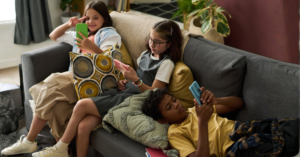
Why Children Screen Time Matters
Children learn best through real-world interaction. For example, movement, play, and conversation are essential for brain development, especially in the early years. When screens take up too much space, these experiences can gradually fade into the background.
Research from the World Health Organization and the American Academy of Pediatrics indicates that excessive screen time may lead to sleep problems, attention difficulties, delayed language development, and higher stress levels in teens. Nevertheless, screens themselves are not the enemy. The real challenge lies in how they are used.
Child psychologist Dr. Jenny Radesky explains, “It’s not just about the hours spent on screens. Rather, it’s about what kids are missing when screens replace play, conversation, and rest.”

Recommended Children Screen Time Limits by Age
Every child is different, but these guidelines provide a helpful starting point. Notably, these limits focus on non-school screen use.
Babies and Toddlers (0–2 years) – Screen Time for Kids
-
Recommended: No screen time, except video calls
-
Why: Babies learn best from faces, voices, and physical interaction
For instance, a short video call with family is fine. On the other hand, passive video watching provides little benefit.
Preschoolers (2–5 years) – Children Screen Time Guidelines
-
Recommended: Up to 1 hour per day
-
Focus: High-quality educational content with adult involvement
Parents should participate in viewing. This approach encourages conversation about what children see and helps connect content to real life.
School-Age Children (6–12 years) – Managing Screen Time for Kids
-
Recommended: 1–2 hours per day outside of schoolwork
-
Focus: Balance with outdoor play, reading, and family time
For example, if a child spends an hour gaming, suggest another hour of outdoor play or helping with small tasks. Similarly, balancing digital and physical activities prevents overreliance on screens.
Teenagers (13–18 years) – Children Screen Time and Digital Habits
-
Recommended: Flexible limits with clear expectations
-
Focus: Sleep, mental health, and online safety
At this stage, open discussion and shared boundaries work better than strict rules. Consequently, guidance becomes more effective than enforcement alone.

Quality Children Screen Time: Why Content Matters
Not all screen time is equal. Educational apps, creative tools, and programs that encourage problem-solving are far more beneficial than endless passive scrolling.
Additionally, content designed to keep children watching without thinking can quickly become problematic. A helpful tip is to observe your child’s mood. If they seem irritable or zoned out after screen use, adjustments are likely needed.
Healthy Digital Habits for Kids
1. Create Screen-Free Zones
Bedrooms and dining areas should be free of screens. As a result, children sleep better, and family conversations improve.
2. Use Consistent Screen Time Routines
Children respond better when expectations are clear. Therefore, schedule screen time after homework or chores rather than allowing constant access.
3. Co-View and Play Together
Whenever possible, join your child during screen use. This not only helps them process content but also gives you insight into their interests.
4. Model Healthy Digital Habits
Parents influence behavior by example. For instance, if adults are constantly on their phones, children are likely to mimic that habit.
5. Protect Sleep and Screen Time Balance
Turn off screens at least one hour before bed. Blue light and stimulation affect sleep, especially for teens. In particular, avoiding late-night screens helps maintain healthy routines.

Common Screen Time Challenges Parents Face
“My toddler cries when I take the phone away.”
Screens may be used to manage emotions. Instead, try music, storytelling, or outdoor play.
“My child needs a tablet for school but ends up gaming.”
Parental controls can help, and keeping devices in shared spaces makes supervision easier.
“My teen says everyone stays online late.”
However, involving teens in setting limits encourages cooperation and shared responsibility.
FAQs About Children Screen Time
- Is educational screen time okay for young kids?
Yes, when limited and interactive. Otherwise, passive viewing should be minimized. - Should screen time be banned on weekdays?
Not necessarily. Consistent daily limits are usually more effective than strict bans. - Does online tuition count as screen time?
School use is necessary, but breaks and good posture remain important. - How do I know if my child has too much screen time?
Look for poor sleep, mood changes, reduced interest in offline play, or frequent arguments over devices.
Conclusion: Screen Time for Kids Checklist
- ✔ Age-appropriate screen time limits
- ✔ Screen-free meals and bedrooms
- ✔ Daily physical activity
- ✔ Consistent sleep routines
- ✔ Open conversations about online content
- ✔ Parents modelling healthy digital habits
Screens are part of modern childhood. However, with boundaries and guidance, children can enjoy technology without it taking over their lives. Ultimately, the goal is balance, connection, and raising children with digital habits that support well-being.